Showing posts with label art influences. Show all posts

Monday, March 16, 2015

Mathematics as Abstract Text

Grids, octagons, X-Y-Z axes, coordinates, parabolas…mathematics are increasing these days in the studio.  Equations, formulas, letters and numbers have become part of the expression.  They accompany geometric shapes and represent an aesthetic relief.


"Let f = F", Gesso on Roofing Felt, 72" x 36", © 2015

In 1982 the third year faculty at the Corcoran College of Art + Design (Washington, DC) became aware of my job experience as a sign maker.  Since then there has been a push to incorporate text into my artwork.  I became very self-conscious about it…what to say?  In those days I took the sign influence into the direction of graffiti.


Washington, DC, Dupont Circle 1984  Photo Richard K. Thomas


As part of a retrospective exhibit in the early 2000’s I painted individual words in a frieze section of the gallery. The selection of words was rife with meaning and hanging my large scale abstract paintings below them created interesting contexts.  

Installation View, "Excerpts", Lees-McRae College, Banner Elk, NC  2007

But text was not integrated into the imagery.

My struggle was with words themselves.  They’re so descriptive that they guide viewers thinking, perception and meaning.  I've had no problem with this as far as titles go. But actually using them in the artwork has continued to make me feel self-conscious.  I’ve tried to use text as texture by burying them under layers of paint but without success.

Now it seems that the use of geometric shapes demands these equations to emphasize the depth of the subject. The math is specific without being literal.  It’s an abstract language.  


"Untitled Hypar", Gesso and graphite on primed matboard, © 2015 Collection Steve Nyland

As such, I enjoy incorporating it freely into these recent artworks.  Many formulas are too long to use but sections are fun to place into these compositions.  The complexity makes for rich content. 
Underpainting, Gesso on Roofing Felt, 2015  https://www.youtube.com/watch?v=7FCVWpCgt1w


Using algebraic formulas touches on some difficult areas for me.  Algebra was incomprehensible when I was a high school freshman.  The basic concept of letters equaling “any number” was beyond me.  My dad taught math and science and worked with me to get a handle on it.  In spite of his tutoring it didn’t connect and was very frustrating!

I revisit these memories often as I continue this series of artwork.  It’s uncomfortable.   Algebra was my great academic melt down.  (Let’s not talk about Speech class.)  


Sunday, February 1, 2015

Focus Project

I’m making thirty identical paintings.  They're each 8” x 10” and modeled after a study of a blue gradient Tree of Life hexagon.  

"Transformation Hexagon"  ©  2015
This image's step-by-step process make it a natural choice for this sort of project.  Focusing on the same shape, same colors, same process, technique and size will yield the same result X 30.


This is the most controversial assignment given by our faculty at the Corcoran College of Art + Design (Washington, DC, 1980’s). However, it was given after 2 months of free range creativity. Nobody mentioned it, but the piles of artwork generated during that first stage were about discovering our modus operandi and ONE image.  

A piece that summed up the range of our unfettered production; our free association, lateral thinking, uninhibited choices in art making that sidestepped our fault-finding, self-filtering, uptight, judgmental fearful selves.

Duplicating that one piece thirty times through the Focus Project was an exercise in discipline and an example of what to do when you found that idea worth pursuing.

Sometimes logistics becomes sculpture.
We do an awful lot of artwork in a lifetime.  We produce drawings and sketches, and ideas that take over our imaginations.  We rush on to generate more ideas, sketches, and proposals…. 


And then what--continue the search for “the next big thing”?  Ugh….

Let’s stay with that brilliant, reduced idea.  Why discard it in the search for another?  They're worth holding onto.  When you find it, focus.  

A focus project brings a meditation on an image, finding out all that it holds and in the process of re-iteration controlled progress reveals itself.  

Side work produced during the current Focus Project.
Thinking becomes ordered, step-by-step instead of random.  Your body of work becomes cohesive and its coherence is evident.  Clarity becomes a trait of your artwork and process.  The directions you take become manageable choices that your clients and fan base follow as well.

Dare to impose a little discipline into the mix.  Hammer out thirty!  You might like it.  If nothing else, you’ll find a few that really sing!  You’ll internalize the image, as well as the focus processes and the multiples aesthetic.  You’ll have that ability and insight as a permanent part of your creative options.  

Who can argue with increasing one’s creative options?  

It’s an investment in yourself; in your discovery.  Your work merits the investigation.  This sort of output declares the importance of your own thinking, research and imagery.

And here’s a surprise:  I’m not making 30 paintings, I’m making one. 

                                                                                                        
 http://jtnwdc.wix.com/jamesthatcherarts                        

Saturday, November 22, 2014

Rebellion Became an Embrace

For about 25 years I was a cabinet maker.   It’s a world of minute detail:  blueprints, trim, and tight spaces.  Add to that delicate finishes, matching color samples, and pristine installations in expensive homes.


Creating large scale abstract art was a way of taking a break from the fastidiousness of the trade.  Throwing, splashing, thrashing, and dripping fields of paint became a refuge from the demands of the industry. 

However, at the turn of the century circumstances led to a break from cabinet making, as I spent several seasons remodeling and finishing my parent’s home in Michigan’s Upper Peninsula.  

About five years later, my bride’s career in higher education took us to the mountains of North Carolina. I found myself back in the field of high end interior woodworking.  


A custom Maple entry door.

After several years of carpentry and drywall, I found myself poorly suited to the demands of cabinet making.  I’d lost my edge….

It took a few years to sharpen up. Those times were marked with frustration and dissatisfaction and eventually with the real estate collapse of 2008 I was laid off.  I’ve kept my tools but haven’t returned to cabinet making.

Deb’s career has gone forward and the opportunity to pursue my art career is in full flight.  I make this preamble to say that I don’t have much to rebel against any more:  times are good.

As such, the thrashing and running paint techniques of my large scale abstract art had become more of a habit than a reality.  Interestingly, now that the requirements of the field are removed I have discovered that the skills and orientation of my woodworking experience persist.


They have filtered back into my creative life.  

After being away for five years the clean lines and processes re-emerge.  I am not back in the shop polishing fine hardwoods, but I am drafting, laying down clean edges, building structures and enjoying the technical facility that decades of shop experience has instilled in me.  Yay!

The contrary days have passed.  These are quieter thoughtful times.  The means have changed, and the ends necessarily so.  What was rebellion has become an embrace. 


Sunday, September 7, 2014

35 Years Later: The Monet Experience

In autumn of 1980 I lived with the Richard K. Thomas family in Potomac, MD for 3 months and ended up staying in Washington, DC for 10 years. During those first months Rich and I would ride into DC almost daily—Rich to his office and post as Chief Economic Correspondent for Newsweek Magazine, me to museums and galleries to gorge on art.


On a visit to the National Gallery (West Wing) I found copyists diligently working before paintings of old.  This was like something out of an art history book where artists of a certain period copied the masters.  I decided I’d better do the same if I had any intention of being a serious artist.

A brilliant job of rendering Rembrandt

Quick conversations with the copyists got me to the Registrar's Office for my own application.  (You can review the process for receiving a copyist permit for the National Gallery's West Wing here.)  A month later, after reference letters, the interview and background checks I was in the mix.  

I made two dreadful renditions of Monet’s “Rouen Cathedral in Afternoon Light”.  One wasn’t enough.  Clearly Monet didn’t have Grumbacher oil paints at his disposal during the late 1800’s…and my canvases weren’t proportioned correctly….  Still it was surprising that the second copy was no better than the first.  Luckily no photo evidence exists of this work.

But the experience is all about the influence, rather than the objects themselves.  Monet’s palette became internalized regardless of mismatching colors.  I chose Monet because I was having color problems, (which continued), but decades later this experience is where I go for color choices and relationships.  

The real deal, Monet's "Rouen Cathedral in Afternoon Light"

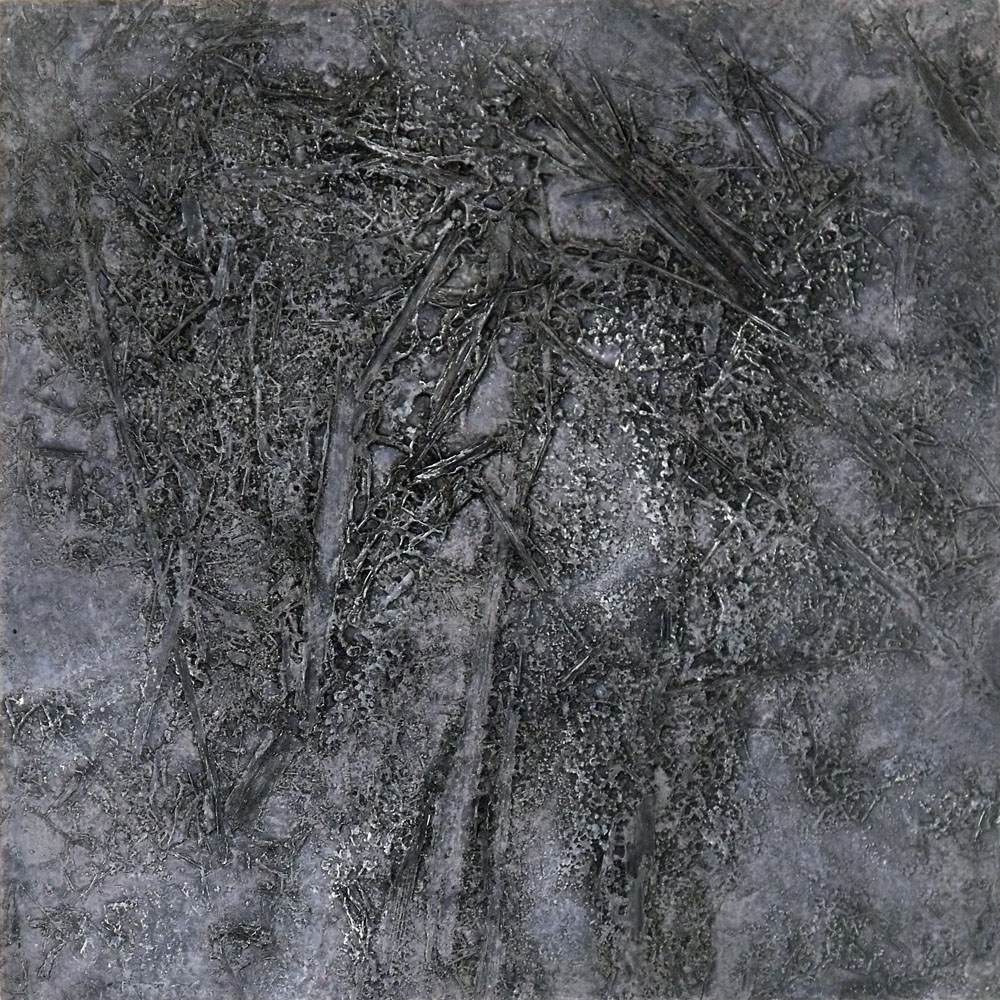
More subtle and surprising was the effect of the Impressionist surface.  Texture has become a subject in its own right in my recent work.  I’ve been doing fairly heavy textures in my artwork since 1992, referencing  Julian Schnabel and Anselm Kiefer's paintings from the 1980’s.  But this interest really traces back to the Monet experience.

Hay and Bulrushes embedded in Latex Paint, 1 of 18, "Arrayed", James Thatcher © 2014

Reducing my imagery in the recent grid paintings, I’ve come to understand the profound influence of copying Monet.  Not in becoming a plein air painter; not in terms of emulating Impressionism, but in fundamental terms of palette and surface texture. 

"After Monet", Cat Litter, Wood Chips, Latex Paints and Acrylic on Canvas, James Thatcher © 2004-2014


Color and texture are my current subject matter.  Thirty-five years later essential elements of the Monet experience fuel my work.  Who would know, who could tell?  It wasn’t exactly copying the “old masters” but it has provided a constant foundation to my paintings and technique.  


"Monet Rouge", Hay, Bulrushes, Latex Paint and Acrylic on Plywood Panel, James Thatcher © 2014

Copying Monet's "Rouen Cathedral in Afternoon Light" hasn’t been the only influence on my artwork, but it has been fascinating to see it in light of current developments in the studio.  I was surprised and wanted to share the discovery.  


Thursday, July 24, 2014

Studio Strategies--The Treadmill!


Consider this idea as you have started to gain momentum in the studio, or have a problem area in your current artwork.


Over the winter I got into the habit of using our treadmill in my studio.  What a great way to look at art!  With nothing else to distract, aesthetic issues get an in-depth viewing with plenty of time to consider, “What if…”


I saw an article on CBS Sunday Morning about incorporating treadmills into the office, with workstations outfitted for pacing.  They made the point that endorphins are released, increasing creative thinking.  I’ve definitely experienced this as I tread before my paintings.

I regularly have concerns about my abstract images.  What’s working, what isn’t; what’s the matter, why doesn’t it work?  Often I will put off decisions about that next step until I’ve had a chance to tread before the artwork.

Sometimes I am anxious as I enter my studio:  what needs doing, deadlines, or ordering my day.  The treadmill is a great way to sort it all out.  It’s perhaps counter intuitive, because I feel urgency about getting started.  But the exercise orders my thinking.  Inevitably, I end my workout knowing what to do and how to do it.

I go for 45 minutes at the beginning of my studio day.  I slowly build up to 3.5 mph at 6 degrees incline.  It takes about 20 minutes to get there; I hold it for 10 minutes, and then back off for the final 15 minutes.  Not a grueling pace, but it gets the job done.  Hydrate!

I’m considering including treadmills in exhibitions of my artwork.  I want to encourage viewers to regard my pieces more thoroughly.  It’s an accomplishment to get 30 seconds of serious consideration for a painting from exhibit attendees…how about 5 minutes from treading? 

5 minutes while looking at an artwork won’t release any endorphins, but that’s a significant increase in viewing time.  What if a treadmill was installed for every painting—or maybe every 2 or 3 pieces?  That would be a more practical arrangement as a number of artworks could be viewed per station.  What about groups of treadmills, so more than one viewer could participate at once? 


Would this encourage interaction between viewers?  Would people become self-conscious? 

The treadmill creates an interactive element, which is novel for a standard exhibition of paintings.  Perhaps this would create opportunities for different kinds of exhibits and venues?  Maybe the gym!

At any rate, if you’ve got the machine give it a try!  I’ve been surprised by the quality of viewing experience.  By the end of my session any aesthetic choices have been well considered.  I have utter confidence going forward.  I've weighed my options, visualized the results and resolved the situation...all before touching brush to canvas.

It’s a great approach to problem solving!  

Friday, September 20, 2013

Art Forgery and Love


"Graphite Grid, Panel #8"; 2014-17, 16" x 16", Hay Embedded in Latex Paint on Wooden Panel
James Thatcher  ©  2017

I understand.   The wealthy want the best and an investment level artwork is bought to be re-sold at a profit; hence galleries, auction houses and private dealers market the works of grand masters.  Who has time to pursue their own investments, because time constraints, expertise and even fear can come into play in their choices?

Perhaps they hire researchers and then make informed choices.  You’ve got to trust your market analyst, your investment counselors, your interior designer; the galleries, critics, museums…
If investors are quick to research, does this zeal translate to their other interests?
"Hypar with Analytic Function"; 2013-17, 88" x 66", Acrylic & Hay Embedded in Latex Paint on Canvas
James Thatcher   ©  2017


Alas.  Few are passionate enough about visual art to make their own inquiries; but these are the ones who generate movement in the art industry.  And perhaps they send in their people to look, to edit choices and recommend the next purchases…it seems practical, no?

"Hypar Z"; 2015-17, 18" x 24", Acrylic on Canvas
James Thatcher  ©  2017


Buyer beware.  The recent art forgery scandal has made many fools.   Wouldn’t it be better to be surrounded by your own choices, by what you’ve discovered and love; as opposed to being sold a false bill of goods?
Why not come to know the keen disappointment of a day spent going from gallery to gallery, seeing nothing of interest?  Eventually you’ll realize the one place that really does have stimulating work…this is your dealer.  You will know that you are intrigued, you think about that artwork when you’re not there, and you’ll know that you must have it.
"Hyperbolic Paraboloid", 2017, 18", Welded Steel
James Thatcher  ©  2017
 In the end, if your passions change or you were merely infatuated with works that weren’t what you once thought, you can donate them to a hospital, a university, or a charity auction receiving full credit of your purchase price as a tax deduction.  So much the wiser.


Come on out and play ball!  Artists want to do good work; they want to sell it and be able to do what they love.  Every collector who gets their nose dirty by actually collecting broadens our industry and stimulates great activity.  Make jobs, have a great time, and change lives—buy your own art!

Study; 2017, 48", Pine
James Thatcher  ©  2017


Sunday, April 28, 2013

Discovering the Broken Obelisk


A sculpture by Barnett Newman, an Abstract Expressionist painter, a precursor to Minimalism; “The Broken Obelisk” is a geometric steel work residing in the courtyard of Mark Rothko’s Chapel in Houston, Texas.


Interestingly, the work was originally installed at the Corcoran Gallery of Art in Washington, DC. Located on the corner of 17th Street and New York Avenue, NW, it was essentially at the entrance of the Corcoran College of Art and Design. My Alma Mater! Displayed there in the late 1960’s “The Broken Obelisk” was considered very controversial, seen as a reference to the Washington Monument and the social discord of the era.

I did visit the Rothko chapel during a short stay in Houston, however my path to realizing the piece followed a study of line drawings based on the square, and its axis’.

 Discovering the piece didn’t have to do with seeing the sculpture. Discovering that it was hidden deep inside the square, only to be found by deconstruction…an excavation…that was exciting!  Recognizing it, discovering it through a process of ideation, in the process of searching out an idea was more than a surprise.
Believing that something worthwhile will be had in searching out the basic, the fundamental, the essential, before you see it, is perhaps the important point here. 

Hope believes that vision will play out meaningfully, given the chance; even in the simplest exercise.

Ideation Drawing, 2013, 8 1/2" x 11"

Studies for "Discovering the Broken Obelisk", 2013, The Art Library, Brooklyn, NY

Who knew that this ideation would lead to a complete break from 25 years of abstract expressionist/surrealist artwork?  Nearly 5 years later I continue investigating related imagery alluding to order and peace beyond our everyday experience.


"Oblique Tetrahedron", 2017, 36", Welded Steel with Powder Coat Finish,  © James Thatcher

http://jtnwdc.wixsite.com/jamesthatcherarts


Saturday, March 16, 2013

Andrew Warhola


Concerning Andy Warhol

           I never met Andy Warhol but I was removed from his presence once.


But that presence seems to inhabit plenty of art work these days…my own included.   Whether I am manufacturing cabinets or knocking out dozens of paintings, the foray into production work hearkens to that 60’s Factory aesthetic; and pays homage. 

I’m surprised to consider The Factory as a precursor to some classic Minimalist artists and their use of industrial practices.  Picture their artwork (as different as it could be both visually and in attitude) as being directly influenced by Warhol:  The cube sculptures of Sol LeWit, the boxes of Donald Judd…He brought multiple imagery to contemporary art, as well as mass production, although the cited Minimalists pursued different ends and means.  Curious….

Portraits of Campbell soup cans (or was that Still Life?) were the uncomfortable birth of something different; made more so by its proximity to the triumph of Abstract Expressionism.  In the immediate wake of the introspective Abstract Expressionists came one who depicted the plainly visible world in iconic fashion. 

Similar to The Ashcan School, with its own depictions of the everyday, Warhol also staked out the territory of everyday life (the boring) as subject matter; as well as the controversy of “urban realism”*.  Consider the early Warhol as an extension of this classic New York interpretation of art/life….

Fun stuff!  …And what about Mr. Brainwash!?


*  Weinberg, H. Barbara. "The Ashcan School". In Heilbrunn Timeline of Art History. New York: The Metropolitan Museum of Art, 2000–. http://www.metmuseum.org/toah/hd/ashc/hd_ashc.htm (April 2010)