Tuesday, March 24, 2020

Tuesday, March 19, 2019
Letter to SeymourPowell
I'm an artist with an idea that happened with the combination of a couple of images in Photoshop.

I believe there is an opportunity to partner with industry/tech to create shaped flat screen displays that could be fastened to structures, conformed to structures, or to joined to each other to create sculptural forms.

Could triangular flat screens be fabricated to display video or images? In the structure illustrated, the bottom could be open for installing electronics, ventilation, and access. It could be either large or small.
I work with octahedrons regularly (eight equilateral triangles). This would create a fascinating screen/object. At this time I'm interested in making a few sculptures that feature this technology. I believe that funding and exhibits are available for such objects and applications. We can conquer the world from there.
Does this technology already exist? Is this brilliant? I am looking for a partner.
I got your name from this article:
https://www.theverge.com/2013/
Sincerely,
James Thatcher
Monday, January 7, 2019
A Letter to Noah Purifoy
Dear Noah,
Thank you for your generosity. Creating the free desert museum in Joshua
Tree, California provided my family with the honor of experiencing your
immersive art in the expanse, rather than in typical white rooms, although the sculptures
would be striking there too.
 |
| Corrugated structure by Noah Purifoy, c. 1987-2004 |
Having the Drinking Fountains positioned near the
entrance creates a heart-breaking context for the entire collection. Have the fountains ever had running
water? Providing drinking water at the site would cause disturbing interactions with those works.
 |
| Drinking Fountain Installation referencing "Separate but Equal" facilities. https://en.wikipedia.org/wiki/Separate_but_equal |
 |
| Detail of "Colored Water Fountain," referencing "Separate but Equal" https://en.wikipedia.org/wiki/Separate_but_equal |
How would it feel to drink there? Privileged, outraged; what about guilt, rebellion, spewing, and trouble...? The fountains are a volatile work with unmistakable content. They influenced all of my thinking as I
wandered through the rest of the artworks.
Ouch.
 |
| Entropic sculpture by Noah Purifoy, c. 1987-2004 |
Feelings of personal and cultural devastation hung over me throughout
your acreage. These are amplified by the
years of entropy, wind, and gravity that pull and twist the works to the earth in
your absence.
 |
| Figure by Noah Purifoy, c. 1987-2004 |
Did you intend for the
gradual effects of time to continue to fashion the works? They work with your assemblage techniques,
pushing the feeling of a life endured under institutionalized degradation; not
from an overt system like prison, but our culture. My culture.
 |
| Entropic sculpture by Noah Purifoy, c. 1987-2004 |
As an artist I understand the joy of making, the freedom and rush as artworks come together, and how they can change by adding a new part. I appreciate the gratification of being absorbed in creating.
 |
| Stack of chairs by Noah Purifoy, c. 1987-2004 |
But I believe that we express ourselves from the abundance of our heart. Does Post-Traumatic Stress Disorder haunt your imagery?
 |
| Metal sculpture by Noah Purifoy, c. 1987-2004 |
The idea of using anything at hand to create a shelter,
wiring it together, piecing…the urgency of your creation speaks of desperation,
of using anything to pull life together.
 |
| Structure by Noah Purifoy, c. 1987-2004 |
Ultimately, what's inside us is what we have to work with. Your power, outrage, sorrow, compassion, and urgency,
conjure up images of shanty towns, homeless encampments, southern Appalachian hovels.
 |
| Structure Interior by Noah Purifoy, c. 1987-2004 |
 |
| Steel sculpture by Noah Purifoy, c. 1987-2004 |
The metal arrangements relate the message abstractly. As linear structures they are
entropic, slouching compositions, but they communicate social
injustice as a part of the whole installation.
 |
| Aluminum sculpture by Noah Purifoy, c. 1987-2004 |
As
abstractions they are dystopian; but in context with the house-like installations they
are direct and real. Dystopia is a
philosophy, but your life experience takes this body of work beyond words.
 |
| Stick sculpture by Noah Purifoy, c. 1987-2004 |
 |
| House structure by Noah Purifoy, c. 1987-2004 |
 |
| Ground arrangement by Noah Purifoy, c. 1987-2004 |
The heaps, whether stockpiles or installations that may have collapsed, are a sad but potent
conclusion in themselves.
 |
| Ground arrangement by Noah Purifoy, c. 1987-2004 |
Piles of stuff for future use, or trade, creates an environment
of disorder. I have seen crushing
poverty operate the same way while in ministry in southern Appalachia.


(Maybe I’m the one with Post Traumatic Stress Disorder.)
Sincerely,
James
Monday, December 17, 2018
"Disarray"
I’ve chosen to paint this portrait on banana box liners
because they’re so awful. They are stained,
crumpled, and gross. They reflect the
nastiness with which we serve the poor and are symbolic of the way we care for people in need.
 |
| James Thatcher Copyright 2018 |
This liner paper is the cheapest available. They come out of the boxes so rumpled that I have to iron the paper to make it possible to use.
I choose to paint with primers instead of “artist colors” for
similar reasons. Gesso is not intended as
a finished surface. It is cheap, stark, and dry looking.
Allowing the brown paper to show as an extra
color follows the rationale of using rough materials used to depict a rough situation.
 |
| Filling in the painting according to plan, but then... |
But the real moment of this project happened because of the brown paper. The head's structure had become confusing. Where did the hair begin and forehead end?
It was awkward so I decided to only use the four center panels of the face. As I continued to work on this cropped center section I had to move a panel aside to keep paint from getting on
it.
BREAKTHROUGH! It looked fascinating. Then I added back several other panels crookedly
which distorted the child’s face.
Consider the awful reality of a young disrupted life and the people we’re
creating. Disintegrated, unstable, disorderly,
chaotic…what was I thinking by lining up those panels so fastidiously in the
first place?
 |
| "Disarray", 2018, 84" x 60", Black & white gesso on banana box liners. James Thatcher Copyright 2018 |
Order is contrary to the form and content of this image. This portrait became terribly expressive and more troubling by rearranging the
pieces.
Success came in a moment and the painting finished quickly. Stay mindful.
Thursday, November 22, 2018
A Pacific Northwest Portfolio
I volunteer at a regional food bank in southern Oregon, which supplies local agencies rather than
individuals. We’ve had difficulty
recruiting volunteers because of this. Part of the problem is that
we do not communicate who we really serve in our facilities, hence to prospective
volunteers.
I’ve begun a project of photographing recipients at the nineteen food pantries and community kitchens served by the United Community Action Network (UCAN) food bank in Douglas and Josephine Counties, Oregon.
I’ve begun a project of photographing recipients at the nineteen food pantries and community kitchens served by the United Community Action Network (UCAN) food bank in Douglas and Josephine Counties, Oregon.
 |
| "Hunger", proposed as a billboard poster, 7' x 14', digital file James Thatcher copyright 2018 |
The idea behind this project is to
communicate who we really serve, those in need, speaking their untold stories in the facilities where we serve them.
Let’s humanize our facilities in order to more effectively engage those who are considering volunteering with us.
Let’s humanize our facilities in order to more effectively engage those who are considering volunteering with us.
 |
| Installation proposal, 24 units, each 20" x 16" x 10". What if it were presented with a pallet of Campbell's Soup, to be donated to the food bank after the exhibit? |
 |
| The nature of “boxness” comes into play constantly: what goes inside the box? |
This portrait featuring Campbell’s soup draws a clear art historical reference, as well as a social reference to soup kitchens from the Great Depression, and a regional reference to the Campbell's Soup production facility just south of Portland, Oregon.
 |
| "Shelf Stable", 2018, 19" x 35", Black and white gesso, latex paint on reconstructed banana boxes, Campbell's Soup, rope light. James Thatcher copyright 2018 |
While conceptually astute, I maintain
a studio for my practice. It’s a practice
that is hands on, technical, and sometimes messy. I draw, paint, build, sculpt,
and install, exploring materials and processes, often eschewing archival
stability.
Cardboard is not archival. Each banana box has seen multiple cycles, and has become stained, stickered and worn.
 |
| "Relief", 20" x 16" x 60", 2018, banana boxes with florescent light. What if several filled a space? |
There is nothing pretty or glamorous about feeding
the hungry. It’s urgent work with individuals who are sometimes
emotional, sometimes desperate, sometimes unwashed. The need is now,
forget tomorrow and its worries.
Archival, really?
 |
| "Food Insecurity", 2018, 96" x 80", Black gesso and latex paint on banana boxes, stapled to loading pallets. James Thatcher copyright 2018 |
However, moving moments can be had in the midst of serving this population….
Meeting the woman in Roseburg who
shows up at 9am and stands, waiting for hours until the doors of the food
pantry open at 1pm, so that she can obtain produce.
The grateful couple
who accessed their local pantry in Reedsport for years, who have now begun
volunteering there.
I met an elderly man
in Myrtle Creek’s food pantry who was a long-distance trucker, and through it
became disabled with sciatica.
It’s caused me to be very conscientious about
how I handle food during my volunteer shifts.
These are the faces of normal
folks: kids, moms, grandparents. Who can afford not to be compassionate?
 |
| "The Light Shines Through Our Imperfections", 2018, 40" x 48", Black and white gesso, latex paint on banana boxes stapled to a loading pallet, two florescent lights. James Thatcher copyright 2018 |
Art as social practice necessarily confronts.
This project began as a critique of UCAN’s lack of communication, while
providing a solution for it. This portfolio expands the discussion about food
insecurity in our region, it promotes the Oregon Food Bank (located in
Portland), and seeks to enlist viewers into the cause.
Change happens one heart at a time.
That includes mine, swept up and renewed in the service to others. The
abundance of this heart expresses itself in artwork that promotes
compassion, encouragement, and hope.
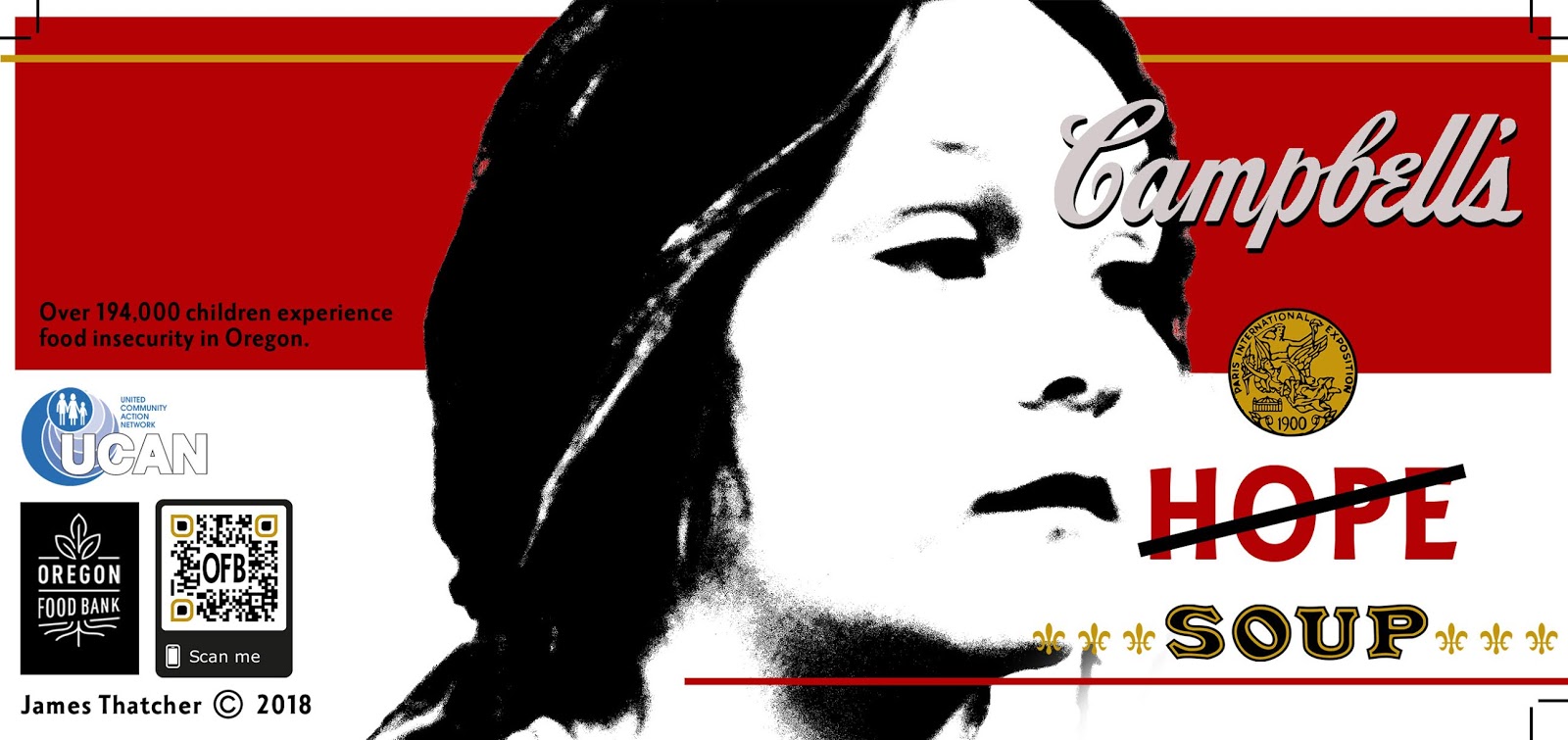 |
| Custom Campbell's Soup can label, 8" x 4" nominal dimension, 2018, digital file. James Thatcher copyright 2018 |
Join me as an agent of cultural evolution.
Sunday, November 18, 2018
Biography as Art Practice
In 1982,
one of my professors at the Corcoran College of Art & Design, Washington,
DC (yes, that Corcoran) said that you could sweep the studio floor and
put it into the artwork I was making.
 |
| "The Spirit of Myth", 2004, 88" x 66", Latex Enamel, dirt, kitty litter, & wood chips on canvas James Thatcher copyright 2018 |
It was 15 years before I actually did that, but the essence of the comment was about making artwork that used the stuff of life as a medium. This concept has led me to embed tree branches, bark, and leaves, or hay in paint, and employ parts and processes from a 24-year career as a cabinet maker into decades of artwork.
 |
| "Chiaroscuro", 2015-18, 48" x 72", Latex enamel, hay, bulrushes, kitty litter on plywood panel. James Thatcher copyright 2018 |
 |
| Detail, "Chiaroscuro", 2018, latex enamel, hay, bulrushes, kitty litter on plywood panel. |
 |
| Installation view, 2014-18, acrylic on canvas. |
But the 2008 financial crisis forced a retirement from cabinet making and changed everything. I joined the staff of a missions-based ministry that I’d been volunteering with in southern Appalachia. We did mission day trips every week, where I experienced the necessity, the power, and the joy of serving “the least of these.”
Now, 10
years later, I have reconnected with that passion as a volunteer for the United
Community Action Network (UCAN) food bank in Roseburg, Oregon. This portfolio is based on that volunteer
work, both emotionally and by “using the stuff of it” as a medium.
 |
| "Portrait Box", one of 4 sides, 2018, 20" x 16" x 10", Black & white gesso, latex paint on banana box. James Thatcher copyright 2018 |
"Portrait Box Rotation", 2018, Black & white gesso, latex paint on banana box.
 |
| "Food Insecurity", 2018, 96" x 80", Black gesso & latex paint on deconstructed banana boxes, stapled to loading pallets. James Thatcher copyright 2018 |
The food distribution system, from the Oregon Food Bank in Portland, to UCAN, to the food pantries and recipients in Douglas County, relies on banana boxes as carriers. As such, banana boxes are the natural choice for a substrate, along with loading pallets, to depict issues of food insecurity.
 |
| Proposed Installation, 24 units, 20" x 16" x 10" Black & white gesso, latex paint on banana boxes James Thatcher copyright 2018 |
This portfolio speaks of my personal history in exploring art materials, of hands-on ministry, of experience in food distribution, and passion for confronting food insecurity.
 |
| "The Light Shines Through Our Imperfections", 2018, 40" x 48" Black & white gesso,latex paint on deconstructed banana boxes, stapled to loading pallet, with two florescent lights. James Thatcher copyright 2018 |
My biography is reflected directly in my art practice.
Tuesday, December 5, 2017

Subscribe to:
Posts (Atom)