Monday, January 19, 2026

"Art as an Act of Rebellion in an Authoritarian Age"

 The following is from an online Threads post from "CMK." 

"Art an an Act of Rebellion in an Authoritarian Age"

by CMK

Authoritarianism begins in silence, first encouraged, then enforced.  It begins with a narrowing of permissible emotions, a shrinking of the imagination, and a disciplining of thought.  Before an authoritarian regime controls bodies, it seeks to control language, culture, and meaning.  It seeks to dictate what is real, what is valuable, and what is acceptable to feel.

In a world like this, creating art becomes a major act of resistance.  Authoritarianism thrives on predictability.  Art doesn’t comply.

"The Spirit of Myth,"  88" x 66", Latex Enamel on Canvas
James Thatcher copyright 2003 

Authoritarian ideologies rest on a belief that everything and everyone must serve a function.  Art refuses to justify itself in those terms. A painting doesn’t explain its usefulness.  A poem doesn’t argue its productivity.  A sculpture doesn’t apologize for being “impractical.”  Art’s refusal to be instrumental makes it politically subversive.

Freedom begins in a realm of activities that can’t be rationalized by totalitarian logic.  Creativity occupies this space.  It’s an assertion that some parts of the human spirit can’t, and shouldn’t be optimized, surveilled, or controlled.

"Black Eyed Boy,"  primer on plastic pallet, 48" x 42", plus wooden shard extensions
James Thatcher copyright 2018

To create art is to assert that meaning is not dictated from above, from a hierarchy.  To linger in beauty is to claim time the state cannot monetize.  Imagining beyond the world as it is represents a threat to those insisting there is no alternative.

Authoritarian rule requires the disciplining human behavior and the colonization of interiority, one’s soul.  It demands emotional conformity:  the correct fears, loyalties, and resentments.  It punishes ambiguity, irony, doubt, and longing.  In essence, it attempts to flatten human complexity into a single sanctioned narrative.  Art refuses that flattening.

It gives shape to private grief, desire, and rebellion.  It nurtures an inner life that the state can’t touch.  Even when created quietly, secretly, or anonymously, art is proof that the self has not surrendered.  Everything we create becomes evidence of human autonomy.

"Oregon Pre-Raphaelite," gesso on banana crate liner paper, 80" x 40"
James Thatcher copyright 2018

Also, authoritarian power depends on the public not looking too closely.  Not at suffering or corruption or the small ways that dignity is shaved thin.  Art disrupts a cultivated blindness.  Art makes the invisible visible, and once it’s seen, it can’t be unseen.

Authoritarians understand this deeply, which is why we see movements banning books, censoring films, and an introduction of “good” police aesthetics.  They tell us that art is a luxury, that it’s frivolous and ridiculous, when in reality, it’s dangerous.  Because art teaches people to look, and looking is the first step toward refusing.

"WJCK," digital photo
James Thatcher copyright 2018

Authoritarian systems rely on the idea that individuals are interchangeable and expendable.  Creativity, however, is inherently personal.  No one else can make the exact mark you make.  No one else can produce your precise shade of longing, or rage, or joy.  Art returns individuality to people whom the regime would prefer to remain faceless.  Art reclaims the agency of the soul.

Perhaps the most radical thing art does is propose worlds that exceed the present.  Authoritarianism depends on the idea that the current order is inevitable and unchangeable.  Art refutes this.  Every story, every image, every facet of creation declares that alternatives are possible, that the human mind is larger than any apparatus of control.  In this sense, art becomes a rehearsal for freedom.  The totalitarian state fears artists because imagination precedes revolution.

"Dance," 44" x 66" x 12", wood and jute sculpture suspended in front of latex enamel painting
James Thatcher copyright 2019

Authoritarian powers relay on abstractions: “the nation,” “the enemy,” “the traitor.”  These categories erase individual histories and complexities.  Art reverses that erasure.  It focuses on particularity, on the lived experience of a single person.  It returns humanity to those whom political systems reduce to symbols.

When you paint someone’s eyes, you restore personhood.  When you write a character’s grief, you make their suffering undeniable.  When you carve a shape from stone, you refuse to let the world remain shapeless.  Art nourishes empathy, and empathy destabilizes authoritarian control.

"Hope," digital file, size variable
James Thatcher copyright 2025

So, keep creating art.

--CKMCreates


Friday, January 2, 2026

Artist's Talk, Dennos Museum, 2025

“Bryn Mawr,” the title of this book, is a Welsh phrase that literally translates to “Big Hill.”  Picture Andrew Wyeth’s classic painting, “Christina’s World,” with the woman sitting in the field and the big house in the distance, on top of that hill… “Bryn Mawr.”


"Christina's World," Andrew Wyeth, 1948

A visiting artist saw the paintings that make the pages of this book in the early ‘90’s. She said that they reminded her of “Bryn Mawr.” It was a reference to the Brandywine School of painting, typified by Wyeth. 

This was a surprise because such imagery was the furthest thing from my mind. The level of detail associated with Andrew Wyeth’s paintings was absent from this artwork.  

"Pa-rurw," 30" x 22", acrylic on paper, 1993

Two distinctly different bodies of work meet in “Bryn Mawr.”  A newer aesthetic overlays paintings from nearly 35 years ago.  As such, not only are they from different times, but they have different motivations, and personal histories.

To put the earlier body of work into context:  I was only sporadically making artwork for about 8 years from the mid 80’s to the early 90’s.  Life was happening; my career as a cabinet maker had begun immediately upon graduating from art school in 1984.  

It was a good vocation, and necessary to make a living. 

While the field started out deeply engaging, over the decades it became a grind.  It was hard work, on your feet all day, and the hours and energy it required stunted what I saw as my studio life. 

Certainly, it’s an artistic field in its own right; but cabinet making is a craft marked by repetition and tedium, as well as regular overtime.  The attention to detail required is anything but expressive.  It is a terribly fussy business to produce other people’s designs.  Your work conforms to blueprints and architects, as well as home owners who are paying a lot for custom furnishings.  

When I did get into the studio, it was to blow off steam; slamming away at very messy, highly textural stuff.  

Thrashing.

But I’ve gotten ahead of myself.
 

Back then, in the mid-80’s, I met and married an artist who was also a graduate of my school, the Corcoran College of Art & Design in Washington, DC.  These were difficult years because neither of us wanted to be burdened with our jobs, each of us having serious studio-artist aspirations.  Eventually, we would leave Washington, DC, and move down to the Atlantic coast, to the idyllic eastern shore of Maryland. 

Unfortunately, within 6 weeks of that move, my wife discovered a lump on her breast, and three years later lost her life to that cancer. 

I was the primary caretaker for those years, and as you might imagine, I made no artwork during this time.

Then one night, about a month after her passing, I was sitting on the sofa watching “Roseanne.”  I said to myself that if I were an artist I would be up in that studio, in my wife’s space, making art.  I turned off that TV and went upstairs to begin a body of work that would continue for 20 years.  The pages of "Bryn Mawr" are from the first years of that series.

After some time, a series of drawings had emerged:  renderings of isolated cubes set in an abstract landscape.  (There was a box-making endeavor happening in my own shop at the time.)  These landscape backgrounds became so compelling that I stopped using the cubes entirely.  The images were reduced to a simple horizon line with different textural fields above and below, as you see in this book.


"The Wilderness of Paran," acrylic on paper, 30" x 22", 1993

 But what does one do with a body of artwork?  The classic artist’s conundrum.  These paintings were never shown.  They were easy enough to store and transport though, being works on paper.

Binding them into a book would make them even more convenient for storage and transportation. However, I don’t see myself as a book artist.  This idea was a matter of convenience and book making is its own art form.

Books imply a narrative, a story.  They start somewhere and then end up somewhere else. This was an issue.  They didn’t go anywhere.  This was just old work and it needed to be more.


"A Promise of Canaan," acrylic on paper, 30" x 22", 1993

Since that original body of artwork nearly 35 years ago, the aesthetic had pivoted from an expressionistic abstract type to a geometric body of work.  I had retired from being a cabinetmaker in the wake of the real estate bubble burst in 2008. 

It took some time to realize it, years in fact, but there was no longer any reason to thrash away in the studio—there was no steam to blow off steam because my frustrating daily grind was over.  A bit of an existential crisis…

We had moved to upstate New York, and took a day trip to visit the Dia: Beacon Foundation.  It was a museum of classic Minimal art, housed in a renovated factory that once produced boxes for the Nabisco Company.  The artwork was impactful:  collections of John Chamberlain’s crushed automobile sculptures, Michael Heizer’s enormous boulders mounted into walls, and Richard Sierra’s huge curved steel walls were heavy hitters.

One morning in the wake of that visit, as I was making the bed I had a conversation in my head with a struggling artist.  I told them that if I were them, I’d get some paper and start making drawings of squares.

Realizing that I was talking to myself, literally, I finished making the bed as quickly as possible, ran to the store and bought a pack of computer paper and sat down to draw those squares.


Ideation Drawing, 11" x 8.5", 2011

To my utter surprise, I found myself longing for the technical demands of custom woodworking!  A lot of skill and discipline had been instilled during 25 years in the field.  I immersed myself in drafting exercises, working through ideations of squares, circles, and the like. 

Now, over 15 years later, this geometric language has transformed considerably through many iterations, resulting in the hexagonal designs on these pages of “Bryn Mawr.”

Rhombus/Hexagon Connections, 2023

This change in aesthetic was an accurate reflection of my life situation, just as the bleak landscapes represented my condition in the wake of my first wife's death.

I was able to retire from work in 2011, because of my current wife’s success in her career in higher education.  Thirty years ago, when we met on a blind date, she was a college professor.  Over time Deb became involved in administration, eventually ascending to the rank of college president!  In 2021 she was also able to retire and is a full-time quilter.

It’s because of her love, success, and indulgence that I’m able to be a full-time studio artist. Thank you, Deb.

This is how the book comes to be.  It is a depiction of the effects of love on a desolate life.  The big hill book, “Bryn Mawr,” is about elevating a former life and allowing the past to be passed.  What is passed provides a background upon which a beautiful, pristine design is presented, rather than being the whole picture.

“Bryn Mawr” is a love story; it’s about the change that love makes.  These few pages reveal a before-and-after combination of completely different styles and techniques that tells a wonderful story.  A story I didn’t even realize until sitting down to write about it.

And they lived happily ever after :)

https://jtnwdc.wixsite.com/jamesthatcherarts

Monday, November 4, 2024

"Bryn Mawr" An Artists book


These abstract landscape paintings-on-paper were completed in 1994.  They never made it to mats and frames so binding them into a book seemed a good presentation.  The geometric designs bring everything up to date with the current portfolio.  Designs are all based on hexagons, and are incised into the painting's surface, then peeled off to reveal clean white lines.  

Tuesday, August 30, 2022

"The Aesthetic Persist"

 Art is a long strange trip.  Pay attention because sometimes it doubles back on itself.

Art leapt forward after nearly 50 drawings in the surrealist “Emergent Image” series.  Number 48 had potential to go further....


Investigation was required. A rendering of the original image streamlined its edges and accentuated the lovely central black shape.  The new drawing looked like a lovely mid-century ceramic sculpture.  

Check out those edges!

This idea ran its course after a few iterations and it was time to return to the series work with so-so results.  But the potential of the "Open Vessel" drawing...time to return for another rendering. 

(bean emergent image)

Flushing out those curves a little and working out the shading…but so what?  Hmm...What if the edges changed?  Another rendering.  Even worse. 

(first two rendering)

But then that wrinkle pattern itself was more interesting than the original shape.  What if the veins were included?  Oh YES.


What if the image were mirrored like a Rorschach print?  Aha.  From nearly 4 dozen random automatic styled drawings into meticulously rendered, highly ordered, intentional imagery.  Some with veins.

Ooh, surprise! Relates to artwork from the early 1980’s, who would suspect?


                               Persistent aesthetic!


Monday, March 30, 2020

"Emergent Images"

"Dream Girl," 2019 Enamel wash and gesso on canvas, 7" x 10"
James Thatcher  2019  copyright


The diminutive “Dream Girl” begged for a larger version.  Replicating textures on a large scale is a recurring issue in the studio.  This was no exception and it has led to a new body of artwork.  

Using hay on a very wet surface would cause a paint wash to gather around the hay and would theoretically result in a frost-like pattern that might approximate that background texture.


Not so much.  But pouring more paint over that experiment created such an interesting result that I didn’t need the girl’s portrait anymore. 

"Dream"  2020  Enamel wash and alfalfa on canvas, 44" x 66"
James Thatcher  2020  copyright 
The question of how to get that frost-like texture continued to puzzle me.  The next attempt was crumpled paper with an added wash.  The way the wash gathered in the wrinkles created wonderful possibilities for free-style composing.  


All other ideas have been banished. 


Success caused me to prepare dozens of crumpled and washed papers to draw into during the coming days.  

Forty papers.
The “Emergent Images” series currently stands at 30 pieces which measure 7” x 10”.  There are a few additional quarter-sheet works.

"Emergent Image #3"  2020  Enamel wash and pencil on paper, 7" x 10"
James Thatcher  2020  copyright
"Emergent Image #10"  2020  Enamel wash and pencil on paper, 7" x 10"
James Thatcher  2020  copyright

"Emergent Image #16"  2020  Enamel wash and pencil on paper, 7" x 10"
James Thatcher  2020 copyright

I look forward to creating drawings using full sheets (22” x 30”) as this series moves forward.


Tuesday, March 19, 2019

Letter to SeymourPowell

I'm an artist with an idea that happened with the combination of a couple of images in Photoshop.  


I believe there is an opportunity to partner with industry/tech to create shaped flat screen displays that could be fastened to structures, conformed to structures, or to joined to each other to create sculptural forms.

Could triangular flat screens be fabricated to display video or images?  In the structure illustrated, the bottom could be open for installing electronics, ventilation, and access.  It could be either large or small. 

I work with octahedrons regularly (eight equilateral triangles).  This would create a fascinating screen/object.  At this time I'm interested in making a few sculptures that feature this technology.  I believe that funding and exhibits are available for such objects and applications.  We can conquer the world from there.

Does this technology already exist?  Is this brilliant?  I am looking for a partner.

I got your name from this article:  

Sincerely,
James Thatcher

Monday, January 7, 2019

A Letter to Noah Purifoy


Dear Noah,

Thank you for your generosity.  Creating the free desert museum in Joshua Tree, California provided my family with the honor of experiencing your immersive art in the expanse, rather than in typical white rooms, although the sculptures would be striking there too.

Corrugated structure by Noah Purifoy, c. 1987-2004
Having the Drinking Fountains positioned near the entrance creates a heart-breaking context for the entire collection.  Have the fountains ever had running water?  Providing drinking water at the site would cause disturbing interactions with those works.

Drinking Fountain Installation referencing "Separate but Equal" facilities.
https://en.wikipedia.org/wiki/Separate_but_equal

Detail of "Colored Water Fountain," referencing "Separate but Equal"
https://en.wikipedia.org/wiki/Separate_but_equal

How would it feel to drink there?  Privileged, outraged;  what about guilt, rebellion, spewing, and trouble...?  The fountains are a volatile work with unmistakable content.  They influenced all of my thinking as I wandered through the rest of the artworks.  Ouch.

Entropic sculpture by Noah Purifoy, c. 1987-2004

Feelings of personal and cultural devastation hung over me throughout your acreage.  These are amplified by the years of entropy, wind, and gravity that pull and twist the works to the earth in your absence.  

Figure by Noah Purifoy, c. 1987-2004

Did you intend for the gradual effects of time to continue to fashion the works?  They work with your assemblage techniques, pushing the feeling of a life endured under institutionalized degradation; not from an overt system like prison, but our culture.  My culture.

Entropic sculpture by Noah Purifoy, c. 1987-2004

As an artist I understand the joy of making, the freedom and rush as artworks come together, and how they can change by adding a new part.  I appreciate the gratification of being absorbed in creating.  

Stack of chairs by Noah Purifoy, c. 1987-2004

But I believe that we express ourselves from the abundance of our heart.  Does Post-Traumatic Stress Disorder haunt your imagery?  


Metal sculpture by Noah Purifoy, c. 1987-2004

The idea of using anything at hand to create a shelter, wiring it together, piecing…the urgency of your creation speaks of desperation, of using anything to pull life together.  

Structure by Noah Purifoy, c. 1987-2004

Ultimately, what's inside us is what we have to work with.  Your power, outrage, sorrow, compassion, and urgency, conjure up images of shanty towns, homeless encampments, southern Appalachian hovels.

Structure Interior by Noah Purifoy, c. 1987-2004

Steel sculpture by Noah Purifoy, c. 1987-2004

The metal arrangements relate the message abstractly.  As linear structures they are entropic, slouching compositions, but they communicate  social injustice as a part of the whole installation.  

Aluminum sculpture by Noah Purifoy, c. 1987-2004
As abstractions they are dystopian; but in context with the house-like installations they are direct and real.  Dystopia is a philosophy, but your life experience takes this body of work beyond words.  

Stick sculpture by Noah Purifoy, c. 1987-2004

House structure by Noah Purifoy, c. 1987-2004

Ground arrangement by Noah Purifoy, c. 1987-2004
The heaps, whether stockpiles or installations that may have collapsed, are a sad but potent conclusion in themselves. 


Ground arrangement by Noah Purifoy, c. 1987-2004
Piles of stuff for future use, or trade, creates an environment of disorder.  I have seen crushing poverty operate the same way while in ministry in southern Appalachia. 


(Maybe I’m the one with Post Traumatic Stress Disorder.) 


Sincerely,

James


Monday, December 17, 2018

"Disarray"


I’ve chosen to paint this portrait on banana box liners because they’re so awful.  They are stained, crumpled, and gross.  They reflect the nastiness with which we serve the poor and are symbolic of the way we care for people in need.  

James Thatcher  Copyright  2018

This liner paper is the cheapest available.  They come out of the boxes so rumpled that I have to iron the paper to make it possible to use.


I choose to paint with primers instead of “artist colors” for similar reasons.  Gesso is not intended as a finished surface.  It is cheap, stark, and dry looking.  

Allowing the brown paper to show as an extra color follows the rationale of using rough materials used to depict a rough situation.

Filling in the painting according to plan, but then...

But the real moment of this project happened because of the brown paper.  The head's structure had become confusing. Where did the hair begin and forehead end?  

It was awkward so I decided to only use the four center panels of the face.  As I continued to work on this cropped center section I had to move a panel aside to keep paint from getting on it.  

BREAKTHROUGH!  It looked fascinating.  Then I added back several other panels crookedly which distorted the child’s face.  

Consider the awful reality of a young disrupted life and the people we’re creating.  Disintegrated, unstable, disorderly, chaotic…what was I thinking by lining up those panels so fastidiously in the first place? 

"Disarray", 2018, 84" x 60", Black & white gesso on banana box liners.
James Thatcher  Copyright  2018

Order is contrary to the form and content of this image.   This portrait became terribly expressive and more troubling by rearranging the pieces.   

Success came in a moment and the painting finished quickly.  Stay mindful.


Thursday, November 22, 2018

A Pacific Northwest Portfolio


I volunteer at a regional food bank in southern Oregon, which supplies local agencies rather than individuals.  We’ve had difficulty recruiting volunteers because of this.  Part of the problem is that we do not communicate who we really serve in our facilities, hence to prospective volunteers.  

I’ve begun a project of photographing recipients at the nineteen food pantries and community kitchens served by the United Community Action Network (UCAN) food bank in Douglas and Josephine Counties, Oregon.  

"Hunger", proposed as a billboard poster, 7' x 14', digital file
James Thatcher  copyright  2018

The idea behind this project is to communicate who we really serve, those in need, speaking their untold stories in the facilities where we serve them.  

Let’s humanize our facilities in order to more effectively engage those who are considering  volunteering with us.

Installation proposal, 24 units, each 20" x 16" x 10".

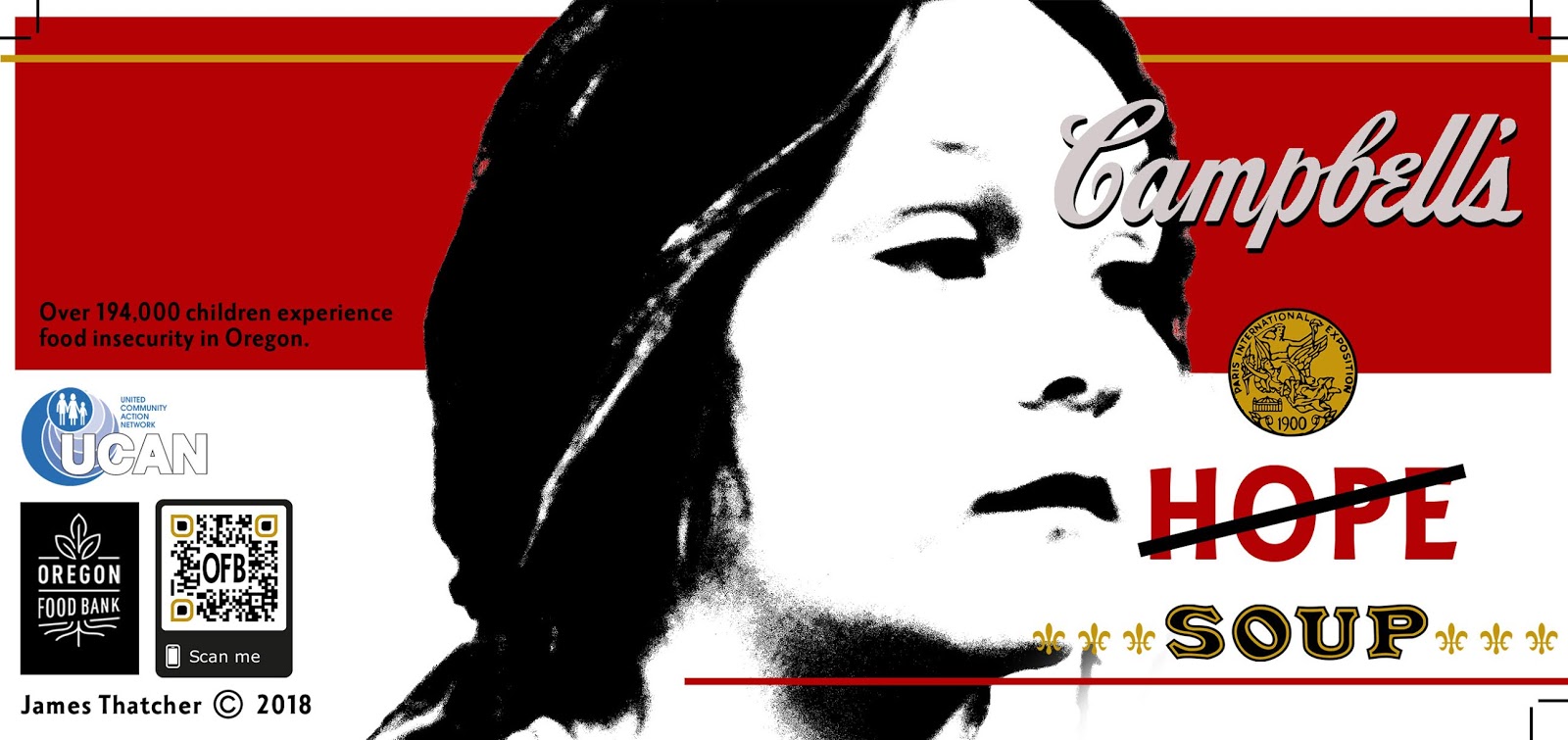
What if it were presented with a pallet of Campbell's Soup,
to be donated to the food bank after the exhibit?

Banana boxes are the ubiquitous containers used to ship, transfer, and distribute food in Oregon, and are an organic choice to support this imagery

The nature of “boxness” comes into play constantly:  what goes inside the box?


This portrait featuring Campbell’s soup draws a clear art historical reference, as well as a social reference to soup kitchens from the Great Depression, and a regional reference to the Campbell's Soup production facility just south of Portland, Oregon. 

"Shelf Stable", 2018, 19" x 35", Black and white gesso, latex paint
on reconstructed banana boxes, Campbell's Soup, rope light.
James Thatcher  copyright  2018


While conceptually astute, I maintain a studio for my practice.  It’s a practice that is hands on, technical, and sometimes messy.  I draw, paint, build, sculpt, and install, exploring materials and processes, often eschewing archival stability. 

Cardboard is not archival.  Each banana box has seen multiple cycles, and has become stained, stickered and worn.

"Relief", 20" x 16" x 60", 2018, banana boxes with florescent light. 
What if several filled a space?

There is nothing pretty or glamorous about feeding the hungry.  It’s urgent work with individuals who are sometimes emotional, sometimes desperate, sometimes unwashed.  The need is now, forget tomorrow and its worries. 

Archival, really?

"Food Insecurity", 2018, 96" x 80", Black gesso and latex paint
on banana boxes, stapled to loading pallets.
James Thatcher  copyright  2018

However, moving moments can be had in the midst of serving this population….  

Meeting the woman in Roseburg who shows up at 9am and stands, waiting for hours until the doors of the food pantry open at 1pm, so that she can obtain produce.  

The grateful couple who accessed their local pantry in Reedsport for years, who have now begun volunteering there.  

I met an elderly man in Myrtle Creek’s food pantry who was a long-distance trucker, and through it became disabled with sciatica.  

It’s caused me to be very conscientious about how I handle food during my volunteer shifts.

These are the faces of normal folks:  kids, moms, grandparents.  Who can afford not to be compassionate?


"The Light Shines Through Our Imperfections", 2018, 40" x 48",
Black and white gesso, latex paint on banana boxes
stapled to a loading pallet, two florescent lights.
James Thatcher  copyright  2018


Art as social practice necessarily confronts.  

This project began as a critique of UCAN’s lack of communication, while providing a solution for it.  This portfolio expands the discussion about food insecurity in our region, it promotes the Oregon Food Bank (located in Portland), and seeks to enlist viewers into the cause. 

Change happens one heart at a time.  That includes mine, swept up and renewed in the service to others.  The abundance of this heart expresses itself in artwork that promotes compassion, encouragement, and hope.
  
Custom Campbell's Soup can label, 8" x 4" nominal dimension, 2018, digital file.
James Thatcher  copyright  2018

Join me as an agent of cultural evolution.